

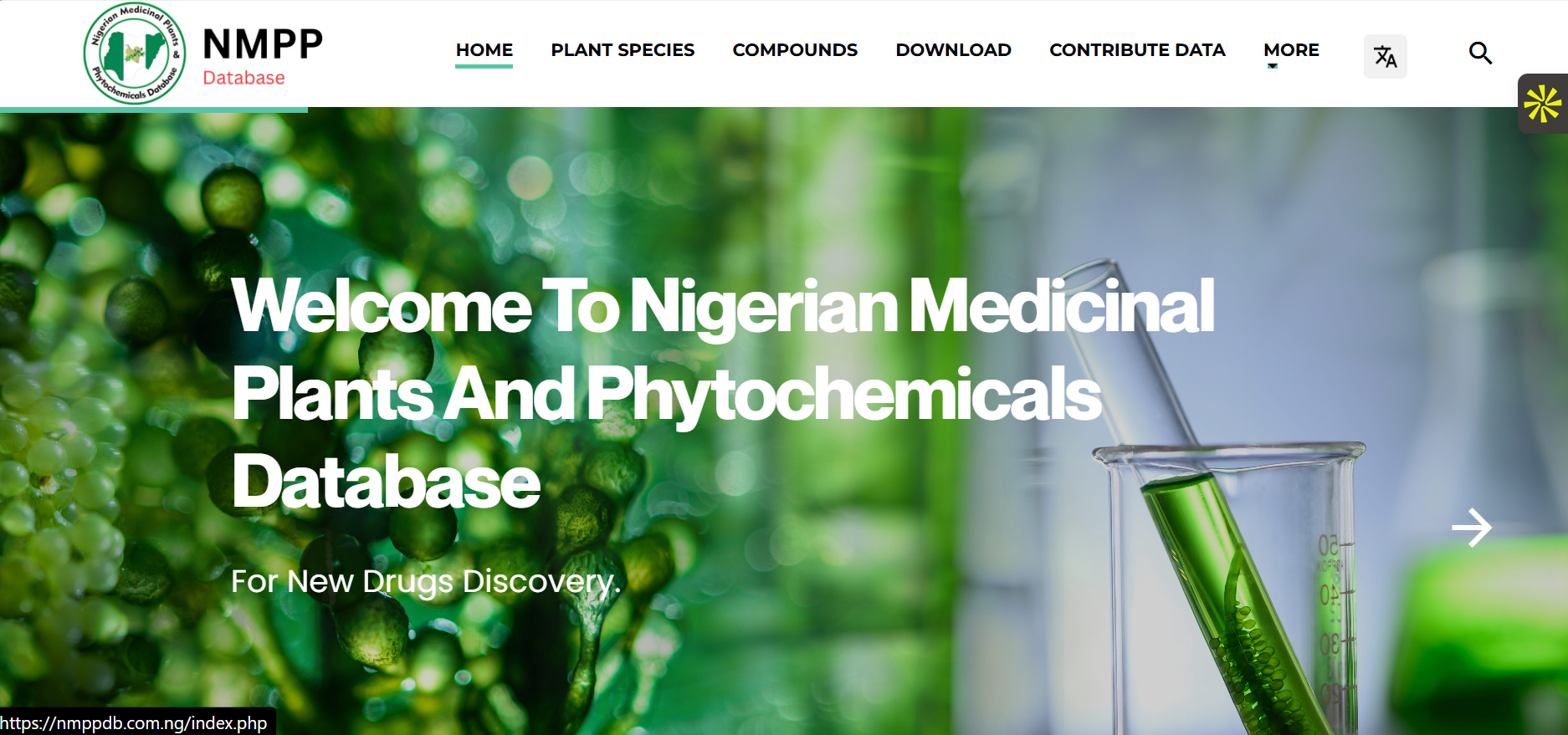
The brief
Nigeria has more than 6,000 documented plant species, and knowledge of their medicinal properties sits scattered across peer-reviewed journals, unpublished theses and individual research groups. A scientist looking for a compound to screen has nowhere single to look.
A university research group, working under a national research fund grant, set out to consolidate that knowledge into one searchable resource. The requirement was not a website about the research — it was the research instrument itself: a relational database other scientists could query, cite in published papers, and download in full for virtual screening.
We delivered the build white-label through a partner agency, which meant the database also had to be documented and handed over cleanly enough for the partner to support it without us.
What we built
Searchable species and compound records
Researchers query by compound, species name or unique identifier and move between linked records, so a compound of interest leads directly to every plant it has been found in.
Full dataset export for virtual screening
The entire database can be downloaded, which is what makes it usable for computational drug discovery. A researcher screening thousands of compounds needs the data locally, not one record at a time.
Community data contribution
Scientists submit their own compounds through the platform, so the dataset grows with the field instead of freezing at its launch version.
Built for academic citation
Published papers behind the dataset are listed with citation guidance, so the database can be properly referenced in academic work — the measure of whether a research tool has actually been adopted.
Multi-language interface
Translation across more than seventy languages, including Hausa, Igbo, Yoruba and Swahili, so the resource reaches researchers outside English-speaking institutions.
How we worked
Delivered white-label through a partner agency, with handover documentation so the partner could support the platform directly.